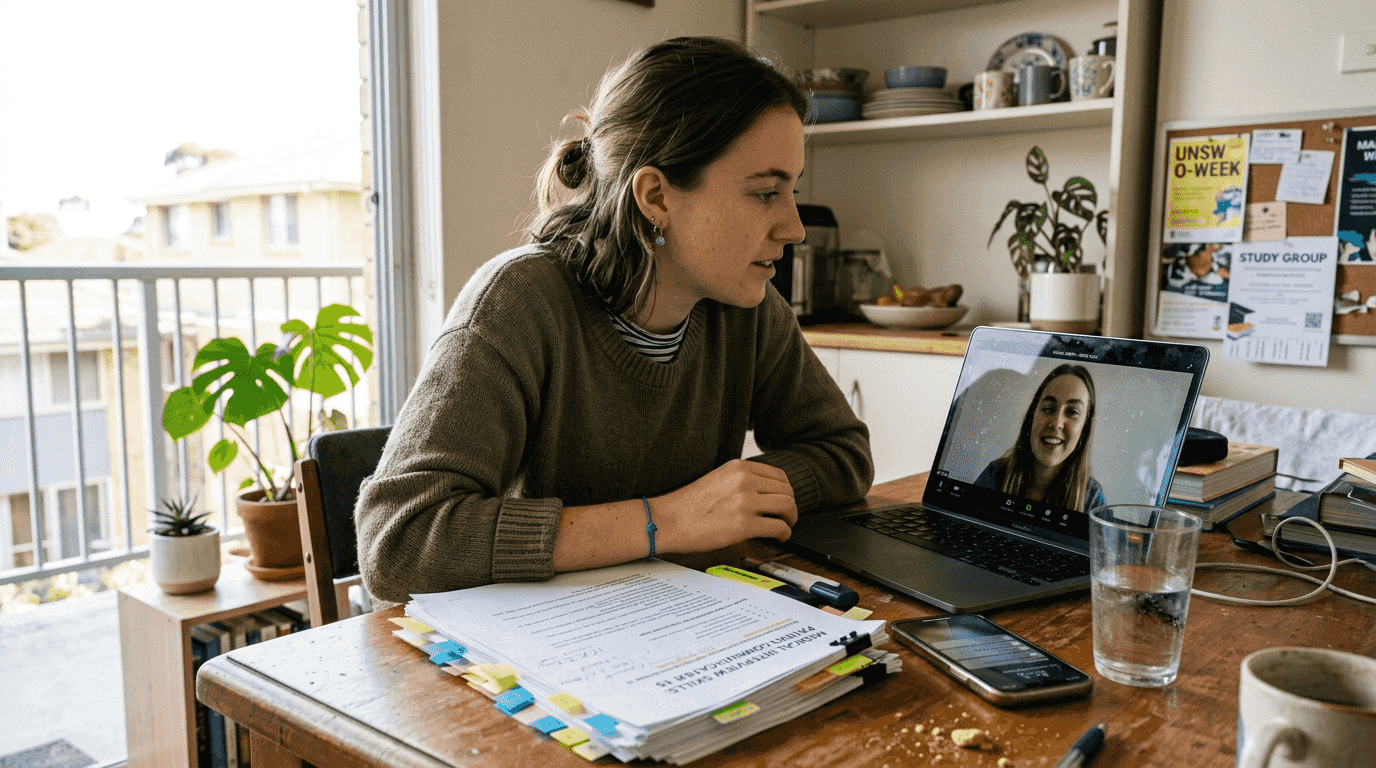
Preparing for medical school interviews in Australia can feel overwhelming, especially when you're unsure where to start or what admissions panels expect. Multiple Mini Interviews and traditional panel formats test your empathy, communication skills, and motivation under pressure. This guide walks you through practical strategies to practise effectively, communicate authentically, and build unshakeable confidence for your interview day.
Table of Contents
- Understanding The Medical Interview Landscape In Australia
- Prerequisites: What You Need Before You Start Preparing
- Step 1: Master The Mmi And Panel Interview Formats
- Step 2: Effective Practice Strategies And Use Of Feedback
- Step 3: Develop Communication And Response Techniques
- Step 4: Technical And Environmental Preparation
- Common Mistakes And Troubleshooting
- Expected Outcomes And Success Metrics
- Boost Your Medical Interview Confidence With Deepmock
- Frequently Asked Questions
Key takeaways
| Point | Details |
|---|---|
| Interview formats | MMIs involve multiple short stations (5-8 stations of 5-10 minutes each) assessing non-academic attributes, while panel interviews allow deeper exploration with fewer interviewers over 20-45 minutes. |
| Effective preparation | Practise at least 20 varied scenario-based questions, use peer feedback and recording tools, and rehearse under timed conditions to build adaptability. |
| Communication balance | Structure responses with flexible frameworks while maintaining authentic, empathetic delivery to avoid sounding robotic. |
| Technical readiness | Test equipment, internet stability, and interview platforms thoroughly for virtual formats to prevent disruptions on interview day. |
| Common pitfalls | Over-rehearsing leads to mechanical answers; misreading prompts wastes time; neglecting empathy weakens responses. |
Understanding the medical interview landscape in Australia
Australian medical schools rely heavily on interviews to select candidates who demonstrate strong interpersonal skills and professional values beyond academic performance. Interview scores typically contribute 33-50% to final admission decisions, making preparation essential for success. Understanding the two primary formats helps you tailor your approach effectively.
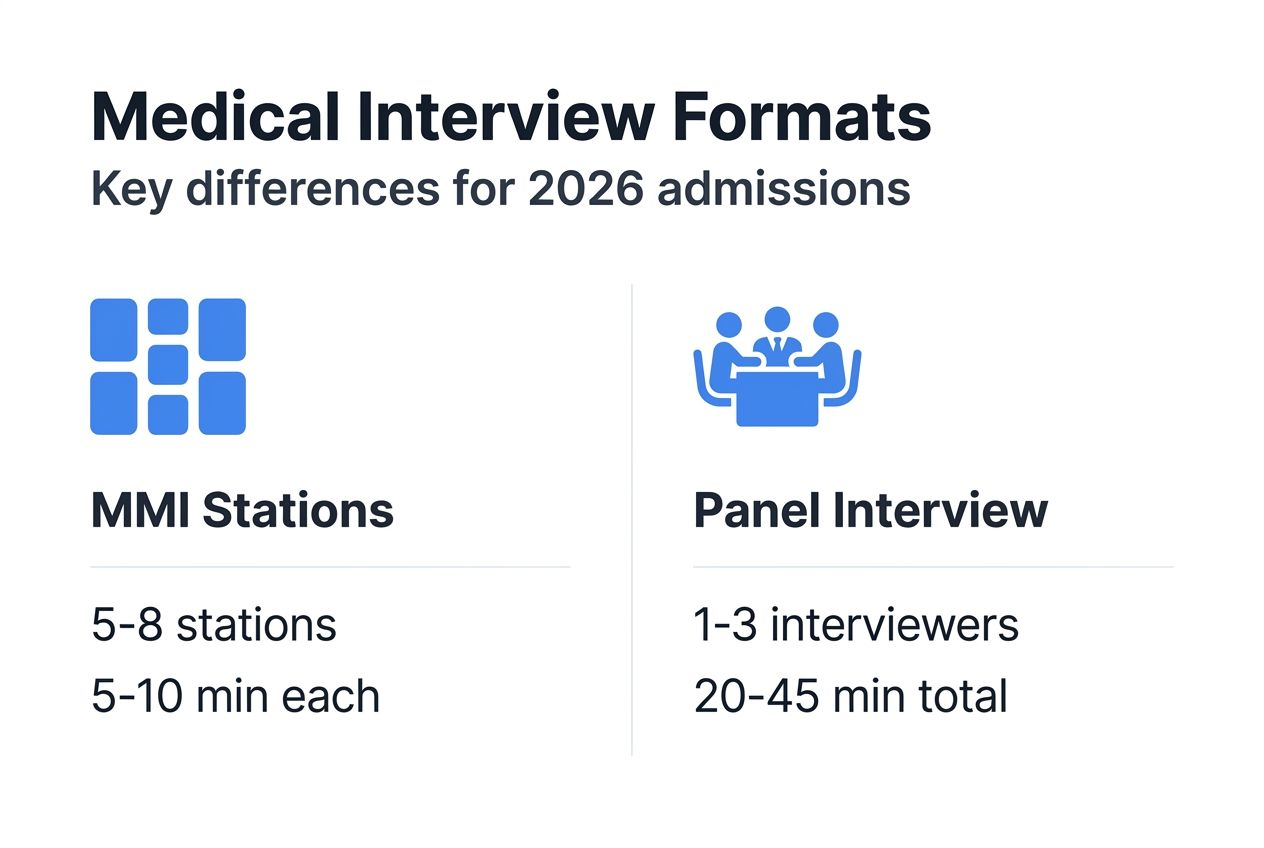
Multiple Mini Interviews in Australian medical schools typically include 5-8 stations, each lasting 5-10 minutes, assessing non-academic attributes across diverse scenarios. You rotate through stations testing ethical reasoning, communication skills, teamwork, empathy, and problem-solving. Each station presents a fresh scenario, requiring quick adaptation and clear thinking under time pressure.
Panel interviews involve 1-3 interviewers in a single session lasting 20-45 minutes. This format allows deeper exploration of your motivations, experiences, and personal reflections. Unlike MMIs, panel interviews maintain continuity throughout, enabling interviewers to follow up on your answers and probe your reasoning more thoroughly.
Understanding these formats before starting medical interview preparation prevents wasted effort and helps you focus practice on skills that matter most. MMIs demand breadth and adaptability across multiple scenarios, whilst panel interviews reward depth and thoughtful articulation of your journey into medicine.
Key differences to consider:
- MMIs test quick thinking and versatility through scenario variety
- Panel interviews assess consistency and depth of personal insight
- MMIs require efficient time management within each station
- Panel interviews allow more natural conversation flow and follow-up questions
- Both formats evaluate communication, empathy, and professional maturity
Prerequisites: what you need before you start preparing
Starting preparation without the right resources and mindset wastes valuable time and increases anxiety. Before diving into practice questions, ensure you have these essentials in place.
First, research your target medical school's specific interview format, dates, and any published guidance materials. Schools sometimes provide sample questions or assessment criteria that reveal what they value most in candidates. This information shapes your entire preparation strategy.
Secure access to authentic scenario-based practice questions that reflect Australian medical interview standards. Generic interview questions won't prepare you for the ethical dilemmas, clinical scenarios, and communication challenges you'll face. Quality practice materials should cover diverse topics including patient autonomy, resource allocation, teamwork conflicts, and cultural sensitivity.
Connect with peers, mentors, or platforms that can provide structured feedback on your responses. Self-practice alone misses blind spots in delivery, body language, and content gaps. Collaborative practice also reduces anxiety by normalising the interview experience.
| Prerequisite | Why it matters | How to obtain |
|---|---|---|
| Interview format details | Tailors practice to actual assessment structure | Check medical school websites and contact admissions offices |
| Scenario-based questions | Builds relevant skills for Australian MMI contexts | Use reputable prep platforms, medical school forums, or prep books |
| Feedback sources | Identifies weaknesses and tracks improvement | Arrange peer mock interviews, mentorship, or expert platforms |
| Recording equipment | Enables self-review and progress tracking | Smartphone camera, laptop webcam, or dedicated recording setup |
| Quiet practice space | Simulates interview conditions without distractions | Designate a home area or book library study rooms |
Familiarise yourself with the core qualities Australian medical schools assess: empathy, ethical reasoning, motivation for medicine, communication skills, teamwork, and personal maturity. Understanding these criteria helps you frame responses that demonstrate these attributes naturally rather than artificially.
Create a distraction-free environment with reliable recording equipment where you can practise speaking aloud without interruption. Practising silently or only mentally rehearsing fails to reveal speech patterns, pacing issues, or awkward phrasing that emerge when verbalising responses under pressure.
Step 1: master the MMI and panel interview formats
Knowing exactly what happens during your interview reduces anxiety and helps you allocate preparation time wisely. Each format tests different aspects of your capabilities and requires distinct preparation approaches.
MMIs assess breadth across multiple attributes with 5-8 stations lasting 5-10 minutes each. You typically receive a written prompt outside each station, have preparation time (often 2 minutes), then enter to respond or participate in a scenario. Stations might involve responding to ethical dilemmas, discussing healthcare topics, acting out communication scenarios with actors, or performing collaborative tasks.
Panel interviews span 20-45 minutes with 1-3 interviewers who ask questions about your experiences, motivations, and perspectives. Panel-style interviews involve fewer interviewers and longer sessions, emphasising depth and continuity, while MMIs assess breadth across multiple attributes with many short stations. This format allows interviewers to explore your answers more deeply and assess consistency in your values and reasoning.
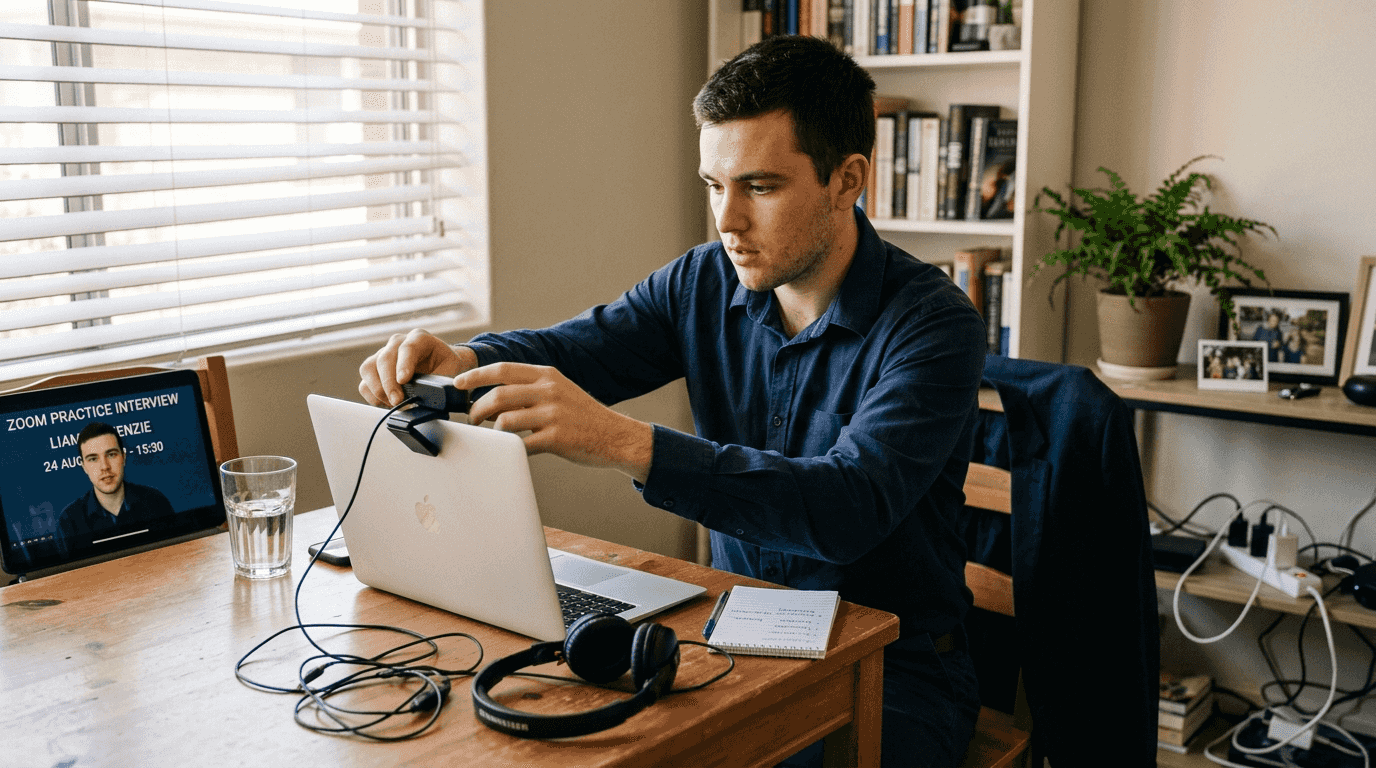
Virtual interviews, increasingly common since 2020, require additional preparation for technical aspects and modified communication techniques. Eye contact shifts from looking at interviewers to looking at your camera. Body language must be more intentional since only your upper body appears on screen. Technical failures can disrupt your rhythm, so backup plans become essential.
| Format aspect | MMI | Panel interview |
|---|---|---|
| Duration per session | 5-10 minutes per station | 20-45 minutes total |
| Number of assessors | Different assessor each station | 1-3 consistent interviewers |
| Primary skill tested | Adaptability and quick thinking | Depth of personal insight |
| Response preparation | Brief reading time between stations | Continuous conversation flow |
| Assessment focus | Breadth across diverse scenarios | Consistency and motivation exploration |
Understanding timing constraints helps you pace responses appropriately. MMI stations require concise, focused answers that demonstrate key attributes quickly. Panel interviews allow more storytelling and detail, but you must still monitor time to ensure all questions receive adequate attention.
Practice both formats separately if your target schools use different methods. Some institutions employ hybrid approaches, combining elements of both. Check specific school requirements early in your medical interview preparation timeline to avoid surprises.
Step 2: effective practice strategies and use of feedback
Random practice without structure yields minimal improvement. Systematic rehearsal with feedback loops accelerates skill development and builds genuine confidence.
- Start by practising at least 20 varied MMI-style questions covering ethical dilemmas, clinical scenarios, personal experiences, teamwork situations, and healthcare policy topics.
- Record every practice session on video, even informal run-throughs, to capture delivery patterns you wouldn't notice otherwise.
- Review recordings critically, noting filler words, pacing issues, unclear explanations, and missed opportunities to demonstrate empathy or reasoning.
- Seek feedback from multiple sources including peers, mentors, or structured mock interview platforms that provide detailed analysis.
- Create a feedback log tracking recurring weaknesses and improvement areas, then target those specifically in subsequent practice.
- Gradually increase difficulty by reducing preparation time, adding unexpected follow-up questions, or practising under mild stress conditions.
Collaborative practice with peers offers unique benefits that solo rehearsal cannot match. Partners catch content gaps, awkward phrasing, and nonverbal communication issues whilst providing realistic interaction dynamics. Peer sessions also normalise the interview experience, reducing anxiety through repeated exposure in a supportive environment.
Pro Tip: After recording a response, wait several hours before reviewing it. Fresh perspective helps you evaluate objectively rather than defensively, making feedback more actionable.
Expert platforms and AI-assisted feedback tools provide structured improvement by identifying specific weaknesses in delivery, content organisation, and time management. These resources complement peer practice by offering consistent assessment criteria and progress tracking over time. Look for tools that analyse both verbal content and nonverbal communication elements.
Space practice sessions across several months rather than cramming in the final weeks. Distributed practice enhances long-term retention and allows time to implement feedback between sessions. Aim for 2-3 focused practice sessions weekly, each targeting different question types or skills.
Step 3: develop communication and response techniques
Knowing what to say means nothing if you cannot communicate it clearly and authentically. Effective response techniques balance structure with genuine expression.
Adopt a flexible framework: understand the prompt fully, structure your answer with a brief introduction, 2-3 main points, and a concise conclusion. Using a structured yet flexible framework to respond to MMI stations allows candidates to organise thoughts effectively without sounding scripted, enhancing authenticity. This organisation prevents rambling whilst keeping you on track under time pressure.
Demonstrate empathy, motivation, and personal maturity through specific examples rather than abstract claims. Saying "I care about patients" carries no weight. Describing how you supported a distressed family member during a health crisis shows empathy through action. Ground your responses in real experiences that reveal character and values.
Avoid sounding rehearsed by adapting answers to each specific question context rather than deploying memorised speeches. Listen carefully to prompts, identify unique elements, and tailor responses accordingly. Interviewers recognise canned answers instantly, and they undermine your authenticity.
Key communication principles:
- Speak at a moderate pace, pausing between ideas to enhance clarity
- Make appropriate eye contact (or camera contact in virtual formats)
- Use natural gestures that complement your words without distraction
- Acknowledge complexity in ethical dilemmas rather than oversimplifying
- Express genuine curiosity about different perspectives
Maintain clarity and brevity to fit within strict time limits whilst covering essential points. Practice identifying the core issue in each prompt quickly, then addressing it directly before elaborating. Peripheral details can wait until main points are established.
Pro Tip: If you lose track mid-response, pause briefly, acknowledge it naturally ("Let me refocus on the key issue here"), then continue. Authenticity trumps perfect delivery.
Balance authenticity with response organisation by preparing frameworks for common question types (ethical dilemmas, teamwork conflicts, personal motivation) whilst leaving content flexible. Know how you'll structure answers, but determine actual content based on each specific prompt. This approach prevents robotic delivery whilst maintaining coherent organisation.
Step 4: technical and environmental preparation
Excellent communication skills mean nothing if technical failures disrupt your interview. Environmental preparation ensures smooth execution on interview day.
Ensure you have stable internet with backup options like mobile hotspot capability. Technical issues in virtual MMIs impact candidate performance; reliable internet and familiarity with video platforms reduce anxiety and ensure smoother interview flow. Test connection speed and stability during times matching your interview slot, as network performance varies throughout the day.
Familiarise yourself thoroughly with video conferencing platforms your medical school uses. Practice joining meetings, adjusting camera and microphone settings, using virtual backgrounds if appropriate, and troubleshooting common issues. Unknown technology adds unnecessary stress on interview day.
Choose a quiet, well-lit, and distraction-free space for the interview. Natural lighting from windows works best, supplemented by lamps if needed to eliminate shadows. Ensure the camera captures you from mid-chest up, positioned at eye level to maintain natural sight lines. Background should be neutral and professional without distracting elements.
Perform comprehensive trial runs well before the interview day:
- Test all equipment including computer, camera, microphone, and lighting
- Verify audio quality by recording yourself and checking for echo or distortion
- Confirm camera angle, framing, and background appearance
- Practice logging into the interview platform and navigating its features
- Run timing drills to ensure your setup location supports focused concentration
Prepare backup plans for common technical failures. Have phone numbers for technical support, alternative devices ready, and a backup internet connection available. Know exactly what to do if your connection drops mid-interview. Most schools provide contingency protocols, so review them thoroughly beforehand.
For in-person interviews, scout the location beforehand if possible. Know parking options, building entry points, and room locations to eliminate uncertainty. Arrive early enough to settle nerves without waiting so long that anxiety builds.
Common mistakes and troubleshooting
Even well-prepared candidates make avoidable errors that undermine performance. Recognising these pitfalls helps you steer clear.
Avoid over-rehearsing to the point where responses sound mechanical and inflexible. Memorising word-for-word answers creates robotic delivery and leaves you vulnerable when questions don't match expectations perfectly. Instead, practise frameworks and key concepts whilst allowing natural expression in the moment.
Read station prompts carefully and completely before responding. Rushing into answers after skimming leads to off-topic responses that miss the question's intent. Use preparation time to identify exactly what the prompt asks, then structure your response accordingly. Misreading costs you dearly since you cannot recover those minutes.
Include empathy and personal reflection rather than purely intellectual analysis. Many candidates default to abstract reasoning about ethical principles without acknowledging emotional dimensions or personal values. Interviewers assess your humanity, not just your logic.
Additional mistakes to avoid:
- Providing yes/no answers without explanation or reasoning
- Dominating collaborative stations without listening to partners
- Becoming defensive or argumentative when prompts challenge your views
- Using medical jargon incorrectly or unnecessarily
- Failing to demonstrate genuine interest in medicine beyond prestige or salary
Practise stress management techniques to maintain calmness and composure under pressure. Deep breathing, positive visualisation, and reframing anxiety as excitement help regulate nervous system responses. Brief physical activity before interviews (walking, stretching) also reduces tension.
Prepare to adapt quickly if technical issues arise during virtual interviews. Have a troubleshooting checklist accessible, stay calm, and communicate clearly with interviewers about any problems. Schools understand technology fails occasionally and will work with you if you handle it professionally.
If you draw a blank on a question, acknowledge it honestly rather than rambling. Asking for a moment to gather thoughts shows self-awareness and composure. Brief silence beats nervous filler that reveals unpreparedness.
Expected outcomes and success metrics
Understanding realistic benchmarks helps you gauge readiness and maintain perspective during preparation.
Preparing for 3-6 months typically improves medical interview performance significantly compared to minimal preparation. This timeframe allows distributed practice, feedback integration, and skill consolidation without burnout. Starting too late increases stress whilst starting too early risks losing sharpness closer to interview dates.
Positive feedback from multiple mock interviews indicates strong communication skills and content quality. If different evaluators consistently praise similar strengths, those represent reliable assets. Conversely, recurring criticism about specific weaknesses demands targeted improvement efforts.
| Success indicator | What it means | How to measure |
|---|---|---|
| Reduced anxiety | Growing comfort with interview formats | Self-assessment and peer observations |
| Consistent feedback themes | Reliable strengths and addressable weaknesses | Tracking comments across multiple mocks |
| Improved timing | Fitting complete responses within time limits | Recording durations and content completeness |
| Authentic delivery | Natural expression without robotic phrasing | Self-review and peer feedback on naturalness |
| Demonstrated core attributes | Clear evidence of empathy, motivation, maturity | Content analysis of recorded responses |
Increased confidence and reduced anxiety serve as key success indicators beyond skill metrics. Feeling prepared mentally and emotionally enables you to perform at your best on interview day. Preparation should build confidence, not undermine it through excessive self-criticism.
Clear understanding of interview structure aids in managing time and content well. When you know exactly what to expect, you allocate mental resources to response quality rather than format navigation. This mastery appears as smooth transitions, appropriate pacing, and complete answers.
Consistently demonstrating motivation, empathy, and maturity across different question types predicts better admission chances. Schools seek candidates who embody these qualities naturally, not those who perform them selectively. Your responses should reveal character authentically, supported by genuine experiences and thoughtful reflection.
Boost your medical interview confidence with Deepmock
Applying these preparation strategies becomes easier with the right tools supporting your journey.
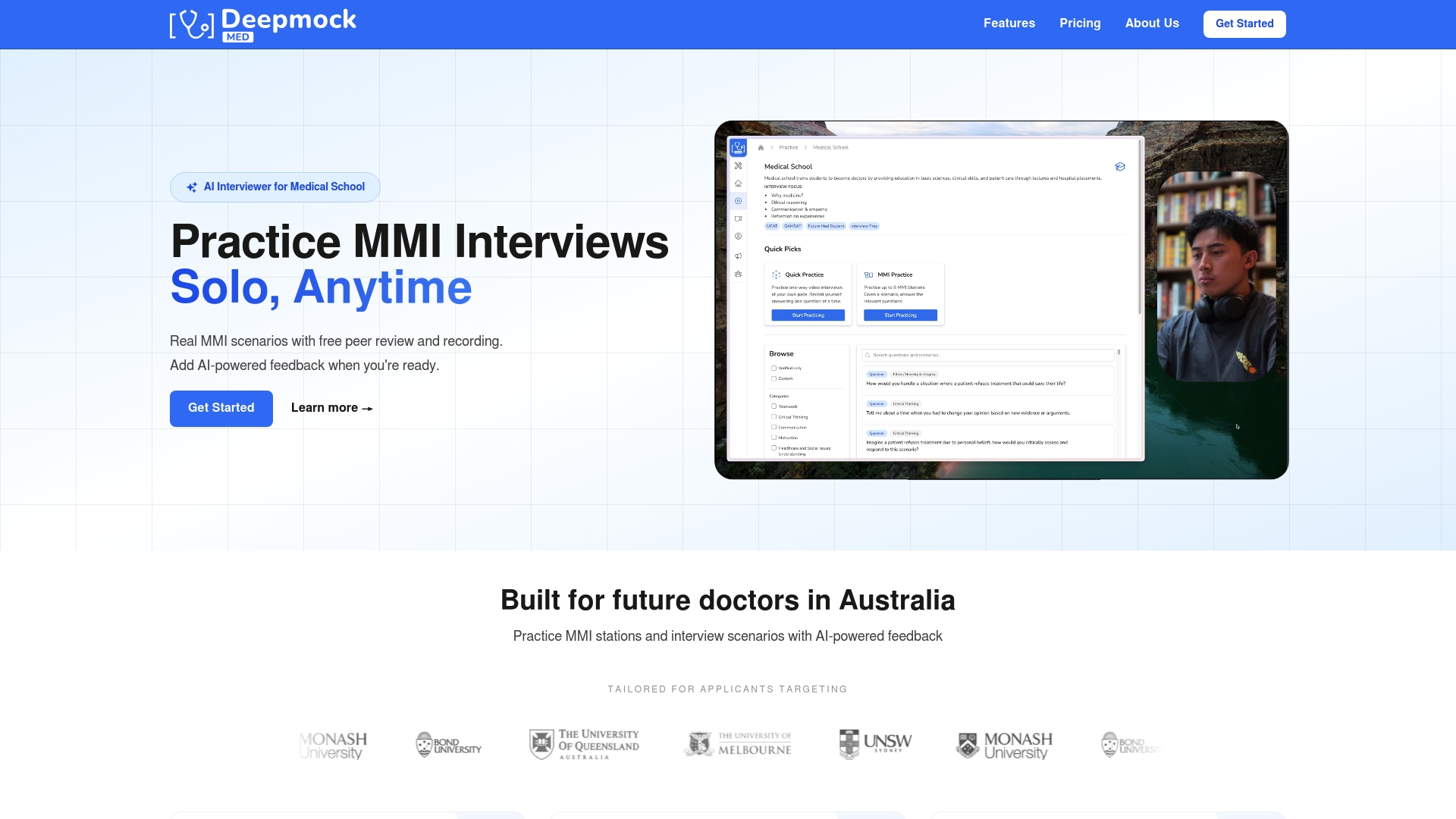
DeepMock offers realistic mock interviews specifically tailored for Australian medical applicants preparing for MMIs and panel interviews. The platform provides scenario-based questions across ethical dilemmas, clinical situations, communication challenges, and teamwork scenarios that mirror actual interview content. You record responses and receive detailed feedback from peers and experts on delivery, content quality, and structural organisation.
Collaborative review features let you share responses with peers for mutual feedback, building community whilst improving your skills. Comprehensive analytics track your progress over time, identifying improvement areas and celebrating strengths. You can customise practice questions to target specific skills needing development.
Flexible pricing plans fit different preparation timelines and budgets, including a free tier with limited analyses and premium subscriptions offering unlimited feedback. Whether you're starting early or cramming before interviews, Deepmock integrates seamlessly with the preparation steps outlined throughout this guide, accelerating your readiness and building genuine confidence for interview day.
Frequently asked questions
How many medical interview questions should I practise before my interview?
Practising at least 20 diverse questions builds adaptability and exposes you to different scenario types you might encounter. Focus on quality over quantity by seeking feedback on each response and implementing improvements. Regular practice across ethical dilemmas, communication scenarios, and personal reflection questions reduces anxiety whilst building flexible response frameworks.
What's the best way to handle nerves during medical interviews?
Practice mock interviews with peers or platforms that simulate actual interview pressure to normalise the experience. Use deep breathing techniques, positive self-talk, and physical relaxation exercises before and during interviews. Reframe anxiety as excitement about the opportunity, and remember that some nervousness demonstrates you care about the outcome.
Should I memorise answers for multiple mini interviews?
Memorising answers risks robotic delivery and poor adaptability when questions differ from expectations. Instead, use flexible frameworks that organise your thinking whilst allowing authentic expression tailored to each specific prompt. Practise key concepts and personal examples you might draw upon, but compose actual responses in the moment.
How should I prepare differently for virtual versus in-person medical interviews?
Test your technology setup thoroughly for virtual interviews, including internet stability, camera positioning, lighting, and audio quality. Practise body language and eye contact differently, looking at your camera rather than the screen to simulate eye contact. For in-person interviews, scout the location beforehand and plan arrival timing carefully. Both formats require quiet, distraction-free spaces, but virtual interviews demand additional technical contingency planning.